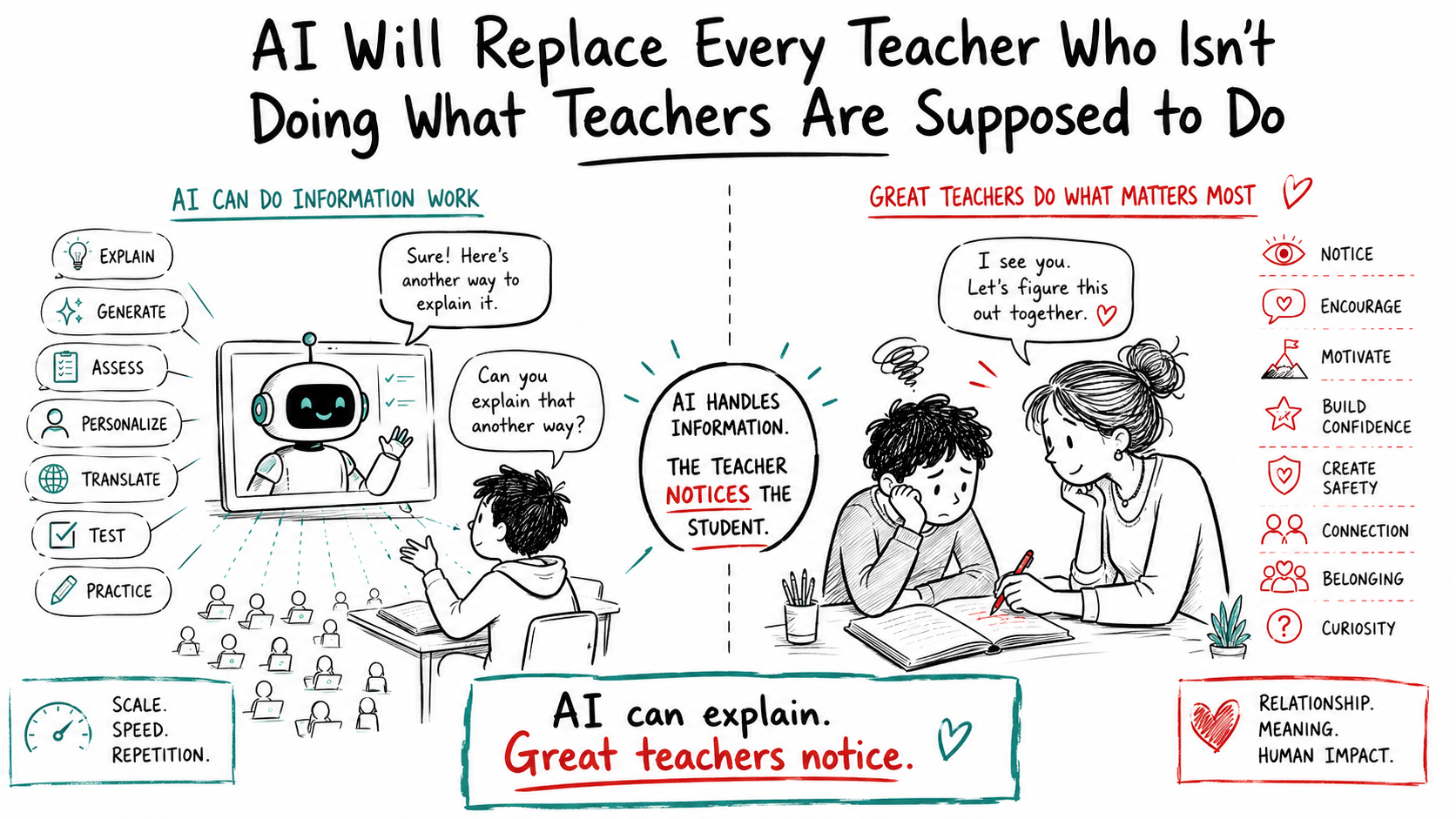
AI can explain, generate, assess, personalize and answer questions at a scale no human teacher can match. That does not make teachers obsolete. It makes the human part of teaching more important than ever.
AI is coming for teachers.
At least, that is one version of the story.
AI can explain almost any concept.
It can generate exercises in seconds.
It can adapt difficulty.
It can answer questions at midnight.
It can translate material.
It can create examples.
It can give feedback.
It can patiently explain the same thing for the twentieth time without getting frustrated.
And it can do all of this for millions of students simultaneously.
So the obvious question is:
Why would we still need teachers?
Maybe that is the wrong question.
A better one might be:
What were teachers supposed to be doing in the first place?
Because if teaching is primarily about transferring information from someone who knows something to someone who does not, AI is going to become extraordinarily difficult to compete with.
But perhaps information transfer was never the most important part of teaching.
Perhaps the arrival of AI is simply forcing us to remember that.
If Your Job Is Delivering Information, You Have a Problem
For centuries, teachers had something students desperately needed:
Access to knowledge.
The teacher knew things.
The student did not.
Books existed, of course, but teachers organized knowledge, explained it, selected what mattered and helped students understand it.
Then the internet changed the equation.
Information became abundant.
Now AI is changing it again.
The student no longer needs to search through ten websites hoping to find an understandable explanation.
They can simply ask:
"Explain this like I'm 14."
Then:
"I still don't understand."
Then:
"Use a football analogy."
Then:
"Give me an easier example."
Then:
"Test whether I actually understood it."
A teacher standing in front of thirty students cannot personalize every explanation this way.
AI can.
That means teachers probably should not try to compete with AI at the things AI is naturally good at.
They should become dramatically better at the things AI cannot easily replace.
A Student Is Not an Empty Container
This is where education sometimes goes wrong.
We treat learning as if the main problem were getting information into someone's head.
But students are human beings.
They get embarrassed.
They compare themselves to others.
They lose confidence.
They become bored.
They hide confusion.
They avoid asking questions because everyone else seems to understand.
They procrastinate.
They arrive at school after arguing with their parents.
They fail three mathematics tests and quietly begin constructing a new identity:
"I'm just bad at math."
AI can generate another explanation.
But another explanation might not be what that student needs.
Maybe they need someone to notice.
The Teacher Who Notices Is Hard to Replace
Imagine two students sitting in the same classroom.
Both score 42% on a test.
The data looks almost identical.
But their situations could be completely different.
One misunderstood a fundamental concept three months ago and everything since then has been built on a weak foundation.
The other understands the material perfectly well but panicked during the test.
One needs remediation.
The other needs confidence.
A system can detect patterns.
Increasingly, AI may detect these patterns extremely well.
But there is another layer.
A teacher might notice that a normally enthusiastic student has stopped raising their hand.
That someone who used to sit with friends suddenly sits alone.
That a student says "I don't care" when what they really mean is:
"I don't want anyone to know how much I care because I'm afraid I'm going to fail."
That is not merely content delivery.
That is knowing another human being.
Sometimes the Most Important Lesson Is Not in the Curriculum
A student may forget the formula you taught them.
They may forget the date of a historical event.
They may forget the structure of a cell.
But they may remember something else for decades.
The teacher who said:
"I think you can do this."
The teacher who stayed five minutes after class.
The teacher who noticed that something was wrong.
The teacher who made them feel that asking a stupid question was safe.
The teacher who refused to let one bad grade become an identity.
The teacher who expected more from them precisely when they expected less from themselves.
Ask adults about the teachers who changed their lives.
How often do they talk about efficient information delivery?
Almost never.
They talk about how that teacher made them feel.
Seen.
Capable.
Curious.
Safe.
Challenged.
Important.
Human.
AI Might Actually Make Great Teachers More Important
This is the part of the AI-versus-teachers debate that interests me.
What if AI does not destroy teaching?
What if it removes some of the machinery surrounding teaching?
Imagine AI handling more of the repetitive work:
Generating exercises.
Creating differentiated material.
Explaining basic concepts.
Checking routine assignments.
Finding knowledge gaps.
Tracking progress.
Producing practice questions.
Adapting difficulty.
Giving students unlimited opportunities to practice.
Then perhaps teachers can spend less time being human information distribution systems.
And more time actually teaching humans.
Talking.
Listening.
Questioning.
Challenging.
Encouraging.
Observing.
Creating belonging.
Building curiosity.
Helping students recover from failure.
Helping someone discover:
"Maybe I'm actually capable of this."
That sounds less like the disappearance of the teacher.
It sounds like the rediscovery of the teacher.
But There Is an Uncomfortable Side to This
AI will not affect every teacher equally.
If the value a teacher provides is primarily:
"I know the material and I will explain it to you,"
then yes — AI is becoming a serious competitor.
If the classroom experience is essentially:
Teacher talks.
Students listen.
Students complete exercises.
Teacher checks answers.
Repeat.
We should at least be willing to ask:
Which parts of that process actually require a human being?
That question may feel threatening.
But avoiding it will not stop technology from improving.
The better question is:
What becomes more valuable when information and explanation become nearly free?
Relationships become more valuable.
Judgment becomes more valuable.
Trust becomes more valuable.
Motivation becomes more valuable.
Meaning becomes more valuable.
Human connection becomes more valuable.
The Future Teacher May Teach Less and Matter More
That sounds contradictory.
It isn't.
Teachers may eventually spend less time explaining things that software can explain perfectly well.
But they could spend more time understanding why someone is not learning.
That distinction matters.
Because sometimes the problem is knowledge.
Sometimes it is motivation.
Sometimes it is confidence.
Sometimes it is a missing prerequisite.
Sometimes it is fear of failure.
Sometimes the student does not know how to study.
Sometimes their life outside school is falling apart.
And sometimes they simply need another person to care whether they succeed.
AI can become an extraordinary learning tool.
But education has never been only about transferring knowledge.
It is also about helping human beings become people who believe they can learn.
Maybe AI Isn't Coming for Teachers
Maybe it is coming for the parts of teaching that never really required teachers.
And perhaps that is exactly what education needs.
Let AI generate the worksheet.
Let AI explain photosynthesis seventeen different ways.
Let AI create the quiz.
Let AI identify the missing prerequisite.
Let AI handle the repetition.
Then give the teacher something far more important:
Time to notice the student.
Because the future of education should not be humans competing with machines at machine-like tasks.
It should be machines giving humans more opportunity to do what humans are uniquely good at.
And that leaves us with an uncomfortable question:
If AI can replace everything you do as a teacher, were you actually doing what only a teacher can do?
At APUOPE, we believe technology should not remove the human element from learning.
It should create more room for it.
AI can help us understand what a learner knows, where they struggle, what they should practice next and how knowledge can be rebuilt.
But learning is more than optimization.
Behind every progress chart is a person.
Behind every wrong answer is a reason.
And behind every student who says "I'm just not good at this" may be someone waiting for a reason to believe otherwise.
The best future for education is not AI instead of teachers.
It is AI doing what machines do best — so teachers can finally focus on what humans do best.